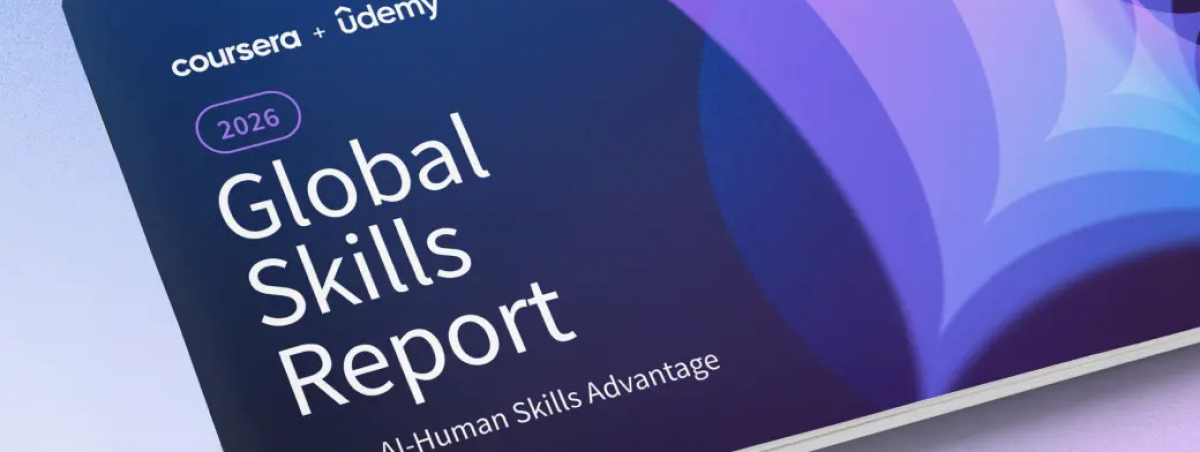
Coursera released the eighth edition of its Global Skills Report on 29 September 2026, drawing on learning data from more than 300 million Coursera and Udemy learners across 98 countries, and the headline is a constructive one for the education sector. Learners are now enrolling in generative AI content at a combined rate of more than 45 enrolments per minute, up from 25 per minute in 2025. Demand for learning has rarely been this visible, and it points directly at where providers, trainers and employer-facing teams can add value next.
The report's most useful idea is that AI skills and human skills grow best together. Three themes follow for education leaders: learner interest is moving from general AI awareness to specific, applied capabilities, human skills are being built alongside technical ones, and a new measure now lets providers benchmark both. Each is an invitation to design stronger programmes, to describe them more persuasively to employers and to grow enrolments.
Interest is becoming more applied and specialised across the platform. Beyond generative AI itself, learners are turning to AI agents, orchestration, security, infrastructure and personalisation, a sign that people want to build, connect and guide AI systems rather than simply use them. That maturity suits education providers well, because applied, project-based digital learning is exactly where structured teaching excellence, expert tutors and strong employer links make the biggest difference.
Human skills are rising in step. The report finds learners developing capabilities that safeguard the quality of AI-supported work, translate governance frameworks into everyday decisions, and help individual contributors lead through influence and coordination. Coursera's companion Job Skills Report points the same way, with critical thinking enrolments rising by an average of 120% year on year across the career areas it analysed, a healthy signal for programmes built around judgement, communication and collaboration.
The new AI-Human Skills Synergy Index gives providers a shared language for all of this. It combines learner proficiency, the breadth of skills being built together and national readiness data drawn from the Government AI Readiness Index. Used thoughtfully, it also offers a straightforward way for institutions to frame their own offer in terms employers already recognise, and to show how their graduates and learners are building capability.
Three practical actions follow for education leadership. First, pair every AI course with a named human-skills component, such as critical thinking or collaboration, so programmes mirror how learners are already building capability and employers can see the connection. Second, gradually shift technologies investment towards applied, project-based delivery in agents, security and data, where interest is growing fastest. Third, use the Index and its skill pairings in employer conversations to show clearly how your programmes support student success and workplace impact.
Education providers are well placed to turn this momentum into lasting competitive advantage. Educational leadership that pairs AI fluency with human judgement now can deliver real education innovation, strengthen employer partnerships and build a reputation for education excellence in the AI era, benefiting learners, providers and the employers who hire them.





.png)